Ephedrine Sulphate (1932), Ephedrine Compound (1932), and Swan-Myers Ephedrine Inhalant No. 66 (circa 1940).
Ephedrine is a non-catecholaminesympathomimetic with cardiovascular effects similar to those of adrenaline (epinephrine): increased blood pressure, heart rate, and contractility. Like pseudoephedrine, it is a bronchodilator, with pseudoephedrine having considerably less effect.[21][22]
Ephedrine may decrease motion sickness, but it has mainly been used to decrease the sedating effects of other medications used for motion sickness.[23][24]
Ephedrine is also found to have quick and long-lasting responsiveness in congenital myasthenic syndrome in early childhood and also even in adults with a novel COLQ mutation.[25]
Ephedrine is administered by intravenous boluses. Redosing usually requires increased doses to offset the development of tachyphylaxis, which is attributed to the depletion of catecholamine stores.[21]
Weight loss
Ephedrine promotes modest short-term weight loss,[26] specifically fat loss, but its long-term effects are unknown.[27] In mice, ephedrine is known to stimulate thermogenesis in the brown adipose tissue, but because adult humans have only small amounts of brown fat, thermogenesis is assumed to take place mostly in the skeletal muscle. Ephedrine also decreases gastric emptying. Methylxanthines such as caffeine and theophylline have a synergistic effect with ephedrine for weight loss. This led to the creation and marketing of compound products.[28] One of them, known as the ECA stack, contains ephedrine with caffeine and aspirin. It is a popular supplement taken by bodybuilders seeking to cut body fat before a competition.[29] A 2021 systematic review found that ephedrine taken in doses from 60 mg to 150mg, with or without caffeine, for 4 to 24 weeks led to a 2 kilograms (4.4 lb) weight loss greater than placebo, raised heart rate, and reduced LDL and raised HDL, with no statistically significant difference in blood pressure.[30]
Ephedrine should not be used in conjunction with certain antidepressants, namely norepinephrine–dopamine reuptake inhibitors (NDRIs), as this increases the risk of symptoms due to excessive serum levels of norepinephrine.[citation needed]Bupropion is an example of an antidepressant with an amphetamine-like structure similar to ephedrine, and it is an NDRI. Its action bears more resemblance to amphetamine than to fluoxetine in that its primary mode of therapeutic action involves norepinephrine and to a lesser degree dopamine, but it also releases some serotonin from presynaptic clefts. It should not be used with ephedrine, as it may increase the likelihood of side effects.[citation needed]
Ephedrine should be used with caution in patients with inadequate fluid replacement, impaired adrenal function, hypoxia, hypercapnia, acidosis, hypertension, hyperthyroidism, prostatic hypertrophy, diabetes mellitus, cardiovascular disease, during delivery if maternal blood pressure is >130/80 mmHg, and during lactation.[33]Contraindications for the use of ephedrine include: closed-angle glaucoma, phaeochromocytoma, asymmetric septal hypertrophy (idiopathic hypertrophic subaortic stenosis), concomitant or recent (previous 14 days) monoamine oxidase inhibitor (MAOI) therapy, general anesthesia with halogenated hydrocarbons (particularly halothane), tachyarrhythmias or ventricular fibrillation, or hypersensitivity to ephedrine or other stimulants.[citation needed]
Ephedrine should not be used at any time during pregnancy unless specifically indicated by a qualified physician and only when other options are unavailable.[33]
Side effects
Ephedrine is a potentially dangerous natural compound; as of 2004 the US Food and Drug Administration (FDA) had received over 18,000 reports of adverse effects in people using it.[34]Adverse drug reactions (ADRs) are more common with systemic administration (e.g. injection or oral administration) compared to topical administration (e.g. nasal instillations). ADRs associated with ephedrine therapy include [35]
Genitourinary: decreased urination due to vasoconstriction of renal arteries, difficulty urinating is not uncommon, as alpha-agonists such as ephedrine constrict the internal urethral sphincter, mimicking the effects of sympathetic nervous system stimulation
Notes: The smaller the value, the more strongly the substance releases the neurotransmitter. See also Monoamine releasing agent § Activity profiles for a larger table with more compounds.
The four stereoisomers of ephedrine.
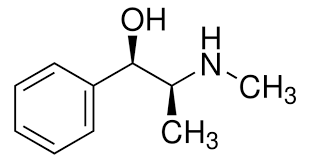
Ephedrine exhibits optical isomerism and has two chiral centres, giving rise to four stereoisomers. By convention, the pair of enantiomers with the stereochemistry (1R,2S) and (1S,2R) is designated ephedrine, while the pair of enantiomers with the stereochemistry (1R,2R) and (1S,2S) is called pseudoephedrine.
The isomer which is marketed is (−)-(1R,2S)-ephedrine.[61]
In the outdated D/L system (+)-ephedrine is also referred to as D-ephedrine and (−)-ephedrine as L-ephedrine (in which case, in the Fischer projection, the phenyl ring is drawn at the bottom).[61][62]
Often, the D/L system (with small caps) and the d/l system (with lower-case) are confused. The result is that the levorotary l-ephedrine is wrongly named L-ephedrine and the dextrorotary d-pseudoephedrine (the diastereomer) wrongly D-pseudoephedrine.
The IUPAC names of the two enantiomers are (1R,2S)- respectively (1S,2R)-2-methylamino-1-phenylpropan-1-ol. A synonym is erythro-ephedrine.
Detection in body fluids
Ephedrine may be quantified in blood, plasma, or urine to monitor possible abuse by athletes, confirm a diagnosis of poisoning, or assist in a medicolegal death investigation. Many commercial immunoassay screening tests directed at the amphetamines cross-react appreciably with ephedrine, but chromatographic techniques can easily distinguish ephedrine from other phenethylamine derivatives. Blood or plasma ephedrine concentrations are typically in the 20–200μg/L range in persons taking the drug therapeutically, 300–3000μg/L in abusers or poisoned patients, and 3–20mg/L in cases of acute fatal overdosage. The current World Anti-Doping Agency (WADA) limit for ephedrine in an athlete's urine is 10μg/mL.[63][64][65][66]
History
Asia
Ephedrine in its natural form, known as máhuáng (麻黄) in traditional Chinese medicine, has been documented in China since the Han dynasty (206 BC – 220 AD) as an antiasthmatic and stimulant.[67] In traditional Chinese medicine, máhuáng has been used as a treatment for asthma and bronchitis for centuries.[68]
In 1885, the chemical synthesis of ephedrine was first accomplished by Japanese organic chemistNagai Nagayoshi based on his research on traditional Japanese and Chinese herbal medicines.
The industrial manufacture of ephedrine in China began in the 1920s, when Merck began marketing and selling the drug as ephetonin. Ephedrine exports from China to the West grew from 4 to 216 tonnes between 1926 and 1928.[69]
Western medicine
Ephedrine was first introduced for medical use in the United States in 1926.[34]
It was introduced in 1948 in Vicks Vatronol nose drops (now discontinued) which contained ephedrine sulfate as the active ingredient for rapid nasal decongestion.
Society and culture
Names
Ephedrine is the generic name of the drug and its BANTooltip British Approved Name.[60][47][70] Its DCFTooltip Dénomination Commune Française is ephédrine while its DCITTooltip Denominazione Comune Italiana is efedrina.[47][70] In the case of the hydrochloridesalt, its generic name is ephedrine hydrochloride and this is its USANTooltip United States Adopted Name, BANMTooltip British Approved Name, and JANTooltip Japanese Accepted Name.[60][47][70] In the case of the sulfate salt, its generic name is ephedrine sulfate or ephedrine sulphate and the former is its USANTooltip United States Adopted Name while the latter is its BANMTooltip British Approved Name.[60][47][70] A synonym of ephedrine sulfate is isofedrol.[60] These names all refer to the (1R,2R)-enantiomer of ephedrine.[60][47] The racemic form of ephedrine is known as racephedrine and this is its INNTooltip International Nonproprietary Name and BANTooltip British Approved Name, while the hydrochloride salt of the racemic form is racephedrine hydrochloride and this is its USANTooltip United States Adopted Name.[71]
In saquinavir synthesis, the half-acid is resolved as its salt with l-ephedrine.
Legal status
Canada
In January 2002, Health Canada issued a voluntary recall of all ephedrine products containing more than 8mg per dose, all combinations of ephedrine with other stimulants such as caffeine, and all ephedrine products marketed for weight-loss or bodybuilding indications, citing a serious risk to health.[77] Ephedrine is still sold as an oral nasal decongestant[78] in 8mg pills as a natural health product (NHP), with a limit of 0.4g (400mg) per package, the limit established by the Controlled Drugs and Substances Act as it is considered as Class A Precursor.[79]
NHPs containing ephedrine or pseudoephdrine as their sole active ingredients are restricted to being behind-the-counter at pharmacies, requiring customers to request them from the pharmacist. Combination NHPs containing other ingredients can be in a regular pharmacy self-selection area for purchase, but are still restricted to pharmacies and a pharmacist must be available to answer questions from a customer if necessary.[80][81][82]
United States
In 1997, the FDA proposed a regulation on ephedra (the herb from which ephedrine is obtained), which limited an ephedra dose to 8mg (of active ephedrine) with no more than 24mg per day.[83] This proposed rule was withdrawn, in part, in 2000 because of "concerns regarding the agency's basis for proposing a certain dietary ingredient level and a duration of use limit for these products."[84] In 2004, the FDA created a ban on ephedrine alkaloids marketed for reasons other than asthma, colds, allergies, other disease, or traditional Asian use.[85] On April 14, 2005, the U.S. District Court for the District of Utah ruled the FDA did not have proper evidence that low dosages of ephedrine alkaloids are actually unsafe,[86] but on August 17, 2006, the U.S. Court of Appeals for the Tenth Circuit in Denver upheld the FDA's final rule declaring all dietary supplements containing ephedrine alkaloids adulterated, and therefore illegal for marketing in the United States.[87] Furthermore, ephedrine is banned by the NCAA, MLB, NFL, and PGA.[88] Ephedrine is, however, still legal in many applications outside of dietary supplements. Purchasing is currently limited and monitored, with specifics varying from state to state.
The House passed the Combat Methamphetamine Epidemic Act of 2005 as an amendment to the renewal of the USA PATRIOT Act. Signed into law by President George W. Bush on March 6, 2006, the act amended the US Code (21 USC 830) concerning the sale of products containing ephedrine and the closely related drug pseudoephedrine. Both substances are used as precursors in the illicit production of methamphetamine, and to discourage that use the federal statute included the following requirements for merchants who sell these products:
A retrievable record of all purchases identifying the name and address of each party to be kept for two years
Required verification of proof of identity of all purchasers
Required protection and disclosure methods in the collection of personal information
Reports to the Attorney General of any suspicious payments or disappearances of the regulated products
Non-liquid dose form of regulated product may only be sold in unit-dose blister packs
Regulated products are to be sold behind the counter or in a locked cabinet in such a way as to restrict access
Daily sales of regulated products not to exceed 3.6g to a single purchaser, without regard to the number of transactions
Monthly sales to a single purchaser not to exceed 9g of pseudoephedrine base in regulated products
The law gives similar regulations to mail-order purchases, except the monthly sales limit is 7.5g.
As a pure herb or tea, má huáng, containing ephedrine, is still sold legally in the US. The law restricts/prohibits its being sold as a dietary supplement (pill) or as an ingredient/additive to other products, like diet pills.
Australia
Ephedrine and all Ephedra species that contain it are considered Schedule 4 substances under the Poisons Standard. A Schedule 4 drug is considered a Prescription Only Medicine, or Prescription Animal Remedy – Substances, the use or supply of which should be by or on the order of persons permitted by State or Territory legislation to prescribe and should be available from a pharmacist on prescription under the Poisons Standard.
South Africa
In South Africa, ephedrine was moved to schedule 6 on 27 May 2008,[89] which makes pure ephedrine tablets prescription only. Pills containing ephedrine up to 30 mg per tablet in combination with other medications are still available OTC, schedule 1 and 2, for sinus, head colds, and influenza.
Germany
Ephedrine was freely available in pharmacies in Germany until 2001. Afterward, access was restricted since it was mostly bought for unindicated uses. Similarly, ephedra can only be bought with a prescription. Since April 2006, all products, including plant parts, that contain ephedrine are only available with a prescription.[90]
Production
Agricultural
Ephedrine is obtained from the plant Ephedra sinica and other members of the genus Ephedra, from which the name of the substance is derived. Raw materials for the manufacture of ephedrine and traditional Chinese medicines are produced in China on a large scale. As of 2007, companies produced for export US$13 million worth of ephedrine from 30,000 tons of ephedra annually, or about ten times the amount used in traditional Chinese medicine.[91]
Synthetic
Most of the l-ephedrine produced today for official medical use is made synthetically as the extraction and isolation process from E. sinica is tedious and no longer cost-effective.[92][unreliable source?]
Biosynthetic
Proposed biosynthetic pathway of ephedrine from L-phenylalanine and pyruvic acid.[93][94]
Ephedrine was long thought to come from modifying the amino acid L-phenylalanine.[95] L-Phenylalanine would be decarboxylated and subsequently attacked with ω-aminoacetophenone. Methylation of this product would then produce ephedrine. This pathway has since been disproven.[95] A new pathway proposed suggests that phenylalanine first forms cinnamoyl-CoA via the enzymes phenylalanine ammonia-lyase and acyl CoA ligase.[93] The cinnamoyl-CoA is then reacted with a hydratase to attach the alcohol functional group. The product is then reacted with a retro-aldolase, forming benzaldehyde. Benzaldehyde reacts with pyruvic acid to attach a 2-carbon unit. This product then undergoes transamination and methylation to form ephedrine and its stereoisomer, pseudoephedrine.[94]
Linear Formula: C6H5CH[CH(NHCH3)CH3]OH ; CAS Number: 299-42-3 ; Molecular Weight: 165.23 ; UNSPSC Code: 12352116 ; NACRES: NA.22.Read more
US$496.00 to US$1,430.00
(-)Ephedrine | CAS No- 299-42-3 | NA
Chemicea Pharmaceuticals
https://chemicea.com › product › (-)ephedrine
Buy high quality (-)Ephedrine with CAS No - 299-42-3 from Chemicea Pharma. Chemicea Pharma is one of the leading manufacturer and exporter of (-)Ephedrine ...Read more
(-)-Ephedrine | 299-42-3 | FE45955
Biosynth
https://www.biosynth.com › Controlled Products
Buy (-)-Ephedrine FE45955 299-42-3 online for pharmaceutical testing. High-quality reference standards for accurate results.
Process materials with specialized cas # 299 42 3 ephedrine from established China wholesale manufacturers. Support chemical processes through specialized ...
CAS Number 299-42-3 | (1R,2S)-(-)-EPHEDRINE, 98
Spectrum Chemical
https://www.spectrumchemical.com › cas › 299-42-3
This item, also known as Ephedrin, presents as a white crystalline solid. It is soluble in water, ethanol, ether, benzene, and chloroform.Read more
Ephedrine | CAS:299-42-3 | Amines | High Purity
BioCrick
https://www.biocrick.com › Ephedrine-BCN9093
BioCrick is a famous high-purity natural products manufacturer. Our Ephedrine is confirmed by NMR. Order now can get a discount!
Pharm-Rx Ephedrine, containing the chemical compound ephedrine, serves over-the-counter (OTC) functions within pharmaceuticals and nutraceuticals.Read more
CAS 299-42-3: Ephedrine
CymitQuimica
https://cymitquimica.com › CAS list
Ephedrine is an organic compound classified as a sympathomimetic amine, primarily known for its stimulant properties. It is a colorless to pale yellow ...Read more
Buy Ephedrine Powder (CAS No. 299-42-3) - Ephedrine CAS No. 299-42-3. Fast Delivery: 1–8 days worldwide, depending on your location; rapid logistics for ...
Dear Sir, We are interested in importing Ephedrine HCL CAS 299- 42-3 into Europe in vast quantities. We would like to know whether you can offer or not.Read more
Reviews
There are no reviews yet.
Be the first to review “Buy Ephedrine Cas 299-42-3” Cancel reply


Reviews
There are no reviews yet.