Interest in α-methyldopamine lies in the fact that 3,4-methylenedioxyamphetamine (MDA) and 3,4-methylenedioxy-N-methylamphetamine (MDMA) may not themselves be responsible for their serotonergicneurotoxicity, as an intracerebroventricular injection does not appear to cause neurotoxicity. While many studies suggest excitotoxicity or oxidative stress as likely mechanisms, which may be an effect of MDMA itself, this has led to the search for other mechanisms for the observed toxicity of serotonin axons and subsequent reduction in serotonin (5-HT) and 5-HIAA (its major metabolite in the body) in vivo following administration. A common theory follows that a metabolite of MDA and MDMA in the periphery must be responsible, and several have been cited as responsible. Although α-methyldopamine is widely cited as the source of this neurotoxicity in a number of lay sources, McCann, et al. (1991), demonstrated that the major metabolites α-methyldopamine and 3-O-methyl-α-methyldopamine (3-O-Me-α-MeDA or HMA) did not produce neurotoxicity.[3]
It was first demonstrated, in 1978, by Conway et al. and possibly others that, while α-methyldopamine caused acute decreases in the levels of neuronaldopamine, in some areas of the brain in excess of 75%, levels returned to baseline within 12hours, indicating that α-methyldopamine could not be responsible for the toxic effects observed.[4]
However, the story complicates as α-methyldopamine readily oxidizes to the o-quinone and reacts with endogenousantioxidants in the body, such as glutathione (GSH). It was demonstrated by Miller et al. (1997), that 5-(glutathion-S-yl)-α-methyldopamine and 5-(N-acetylcystein-S-yl)-α-methyldopamine produced similar effects to the parent compound, but did not induce neurotoxicity when injected intracerebroventricularly. However, the derivative metabolite 2,5-bis-(glutathion-S-yl)-α-methyldopamine (injected at ~1.5times the usual per-kg MDMA dose) did in fact induce neurotoxicity, providing initial evidence that this metabolite may be the source of neuronal toxicity following the administration of MDA and MDMA, and the subsequent reduction in serotonergic axons.[5]
In spite of the above, there is also evidence that metabolites may not be involved in the neurotoxicity of MDMA or related drugs and that the neurotoxicity is intrinsic to their mechanism of action, specifically simultaneous induction of serotonin and dopamine release.[6][7] Accordingly, while single injections of MDMA directly into the brain have not been found to produce neurotoxicity, slow infusions of MDMA into the brain over 1hour do result in signs of neurotoxicity.[6]
Chemistry
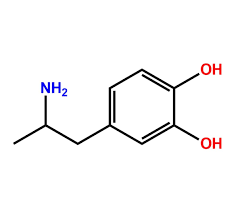
α-Methyldopamine, also known as 3,4-dihydroxy-α-methylphenethylamine or as 3,4-dihydroxyamphetamine, is a substituted phenethylamine, catecholamine, and amphetaminederivative. It is the α-methylated or amphetamine analogue of dopamine (3,4-dihydroxyphenethylamine).
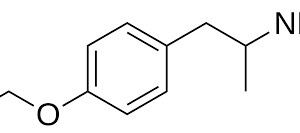
Analogues of α-methyldopamine include corbadrine (levonordefrin; α-methylnorepinephrine; 3,4,β-trihydroxyamphetamine), dioxifedrine (α-methylepinephrine; 3,4,β-trihydroxy-N-methylamphetamine), and hydroxyamphetamine (norpholedrine; α-methyltyramine; 4-hydroxyamphetamine)
α-Methyldopamine (α-Me-DA, CAS 555-64-6) is a chemical compound with the molecular formula
. It is primarily recognized in scientific literature as a metabolite of certain substituted amphetamines and as a monoamine releasing agent.
In a laboratory or clinical setting, it is used as a research standard or for pharmacological studies. It is important to distinguish this compound from α-Methyldopa (CAS 555-30-6), which is a regulated medication used to treat high blood pressure.
This substance is typically handled only by qualified professionals in controlled environments. It is not intended for human consumption or unauthorized use, as it can have significant physiological effects and potential neurotoxicity. Access to such research chemicals is generally restricted to licensed institutions and verified laboratories through industrial chemical distributors. For safety information, one should consult the Material Safety Data Sheet (MSDS) provided by authorized chemical manufacturers.
Alpha-Methyldopamine | 555-64-6 - SynZeal
This page contains information about Alpha-Methyldopamine. Buy high quality Alpha-Methyldopamine from SynZeal Research PVT LTD. CA...
SynZeal
α-Methyldopamine - Wikipedia
α-Methyldopamine (α-Me-DA), also known as 3,4-dihydroxyamphetamine (3,4-DHA or HHA) or as catecholamphetamine, is a research chemi...
Wikipedia
Α-Metildopamina – Wikipédia, a enciclopédia livre
α-Metildopamina (α-Me-DA), também conhecida como 3,4-diidroxianfetamina (3,4-DHA ou HHA), é uma neurotoxina e droga em desenvolvim...
Buy Alpha-Methyldopamine CAS No- 555-64-6, a high quality product from Simson Pharma Limited, a Leading Manufacturer and Exporter of Alpha-Methyldopamine ...
This page contains information about Alpha-Methyldopamine. Buy high quality Alpha-Methyldopamine from SynZeal Research PVT LTD. CAS 555-64-6167.2,C9H13NO2.
Look through (±)-α-Methyldopamine MSDS details show. We provide (±)-α-Methyldopamine 555-64-6 safety data sheet view and download for free at Echemi.com.
Cas 555-30-6,Methyldopa
LookChem
https://www.lookchem.com › casno555-30-6
Methyldopa, also known as α-Methyldopa, is an α-methoxylated derivative of levodopa that exhibits hypotensive action by reducing overall peripheral vascular ...Read more
Methyldopate: A prodrug form of methyldopa. CAS Number: 6014-30-8. Synonym: α-Methyldopa ethyl ester. Purity: ≥95%.
Missing: Methyldopamine Me- 555-64-6
People also ask
What is the brand name for alpha methyldopa?
Is methyldopa dopamine safe during pregnancy?
Does methyldopa increase dopamine?
What is the CAS number of methyldopa?
CAS 555-30-6: Methyldopa
CymitQuimica
https://cymitquimica.com › CAS list
Methyldopa, with the CAS number 555-30-6, is an antihypertensive medication primarily used to treat high blood pressure, particularly in pregnant ...Read more
Reviews
There are no reviews yet.