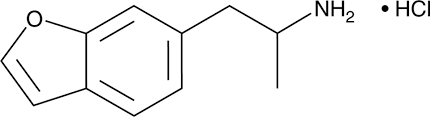
, also known as 6-(2-aminopropyl)benzofuran, is an entactogen of the phenethylamine, amphetamine, and benzofuran families.[1][2] 6-APB and related drugs are sometimes informally called "Benzofury" in media reports. It is similar in structure to MDA, but differs in that the 3,4-methylenedioxyphenylring system has been replaced with a benzofuran ring. 6-APB is also the unsaturated benzofuran derivative of 6-APDB. It may appear as a tan or brown grainy powder.[citation needed]
While the drug never became particularly popular, it briefly entered the rave and underground clubbing scene in the UK before its sale and import were banned. It falls under the category of research chemicals, sometimes called "legal highs" if uncontrolled. Because 6-APB and other substituted benzofurans have not been explicitly outlawed in some countries, they are often technically legal, contributing to its popularity.[citation needed]
6-APB was first described in the scientific literature in 2000[3][4][5][6] and emerged as a novel designer drug in 2010.[4][5][7]
The pharmacokinetics of 6-APB have not been studied, however, some information can be extracted from user reports.[4] These suggest a slow onset of 40 to 120minutes.[4] The drugs peak effects last 7hours, followed by a comedown phase of approximately 2hours, and after effects for up to 24hours.[4]
Synthesis of 6-APB and its structural isomer 4-APB[14]
The chemical synthesis of 6-APB has been described.[6] The synthesis by Briner and colleagues[6] entailed refluxing 3-bromophenol with bromoacetaldehyde diethylacetal and sodium hydride to give the diethyl acetal, which then was heated with polyphosphoric acid to give a mixture of bromobenzofuran structural isomers: 4-bromo-1-benzofuran and 6-bromo-1-benzofuran. The isomers were separated by silica gelcolumn chromatography, then converted to their respective propanone derivatives, and then reductively aminated to give 6-APB and 4-APB, both of which were converted to their HClion pairs for further examination.
Reagent results
6-APB and its structural isomer 5-APB have been tested with a series of agents including: Marquis, Liebermann, Mecke, and Froehde reagents.[15] Exposing compounds to the reagents gives a colour change which is indicative of the compound under test.
6-APB succinate is reported to be practically insoluble in CHCl3 as well as very minimally soluble in cold water. A batch seized by the DEA contained a 2:1 ratio of succinate to 6-APB.[14]
In 1999, amphetamines were changed from Schedule III to Schedule I as a result of the Safe Streets Act. Some have speculated that 6-APB's structure qualifies it as a Schedule I drug as an analog of MDA.[17][unreliable source?]
In 2014, a study funded by the Canadian Institutes of Health Research noted that 6-APB "may or may not be legal in Canada depending on how one interprets the current Act"[18] and that it could be purchased for academic purposes without an exemption from Health Canada. The study also noted how, unlike the MDMA it often serves as a replacement for in countries like the US, 6-APB's benzofuran structure does not make it a direct analogue of amphetamine despite similarities in effects.
China
6-APB has been a controlled substance in China since 1 July 2024[19]
Finland
6-APB is scheduled in government decree on narcotic substances, preparations and plants and hence is illegal.[20]
In Luxembourg, 6-APB is not cited in the list of prohibited substances.[23] Therefore, it is still a legal substance.
Netherlands
6-APB, as well as multiple substances based on the phenylethamine structure, like most cathinones and amphetamines, are banned under the Opium Law since July 1st, 2025,[24] following an amendment to deal with New Psychoactive Substances (NPS) in the Netherlands. Since this is a structural ban instead of a direct one, later substances that differ slightly but use the same skeleton will also be preemptively banned.
New Zealand and Australia
Certain countries contain a "substantially similar" catch-all clause in their drug law, such as New Zealand and Australia. This includes 6-APB as it is similar in chemical structure to the class A drug MDA, meaning 6-APB may be viewed as a controlled substance analogue in these jurisdictions.[25]
Sweden
In Sweden, as of 27 December 2009 6-APB is classified as "health hazard" under the act Lagen om förbud mot vissa hälsofarliga varor (translated Act on the Prohibition of Certain Goods Dangerous to Health).[26]
It is also classified as a narcotic substance since 2020.[27]
United Kingdom
On June 10, 2013 6-APB and a number of analogues were classified as Temporary Class Drugs in the UK following an ACMD recommendation.[12] This means that sale and import of the named substances are criminal offences and are treated as for class B drugs.[28] On November 28, 2013 the ACMD recommended that 6-APB and related benzofurans should become Class B, Schedule 1 substances.[12] On March 5, 2014 the UK Home Office announced that 6-APB would be made a class B drug on 10 June 2014 alongside every other benzofuran entactogen and many structurally related drugs.[29]
CAS Registry Number, 286834-85-3 ; Molecular Formula, C11H13NO ; Molecular Weight, 175.22702 ; EINECS ; Other Registry Numbers, ;.
6-APB
Wikipedia
https://en.wikipedia.org › wiki › 6-APB
6-APB, also known as 6-(2-aminopropyl)benzofuran, is an entactogen of the phenethylamine, amphetamine, and benzofuran families. 6-APB and related drugs are ...Read more
6-APB Cas 286834-85-3 China manufacturer (ada@whzcchem.com ...
cphibiz.com
http://www.cphibiz.com › Sell › Intermediates
6-APB Cas 286834-85-3 China manufacturer (ada@whzcchem.com skype: ada.ren11) ; Model: Pharmaceutical intermedicates ; Price, 1.00RMB/Gram, Enquiry ; Min. Order: 10 ...
6-APB Powder buy in the online store with fast delivery | rchemic
rchemic.com
https://rchemic.com › Shop
6-APB Powder. $40.00 – $2,950.00 Price range: $40.00 through $2,950.00. Formal Name: 1-(1-benzofuran-6-yl)propan-2-amine. CAS Number: 286834-85-3. Formula ...Read more


Reviews
There are no reviews yet.