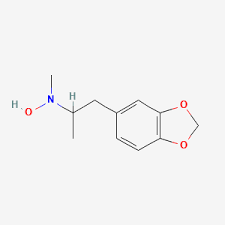
In his book PiHKAL (Phenethylamines I Have Known and Loved), Alexander Shulgin lists FLEA's dose as 100 to 160mg orally and its duration as 4 to 8hours.[1] He describes FLEA as producing entactogenic and open MDMA-like effects, easing communication, and increasing appreciation of the senses.[1] He has noted that the properties and effects of the closely related drug MDOH are very similar or near-identical to those of MDA, and that MDOH might be converted into MDA in the body.[1]
Alexander Shulgin explained the reasoning for naming the compound "FLEA" in his book PiHKAL (Phenethylamines I Have Known and Loved):[1]
Of course, I was asked, why call it FLEA? The origin was in a classic bit of poetry. A commonly used code name for MDMA was ADAM, and I had tried making several modest modifications of the MDMA structure in the search for another compound that would maintain its particular music without the annoying tooth-grinding and occasional nystagmus, or eye-wiggle, that some users have mentioned. One of these was the 6-methyl homologue which was, with some perverse logic, called MADAM. And, following this pattern, the 6-fluoroanalogue was to be FLADAM. So, with the N-hydroxy analogue, what about HADAM? Which brought to mind the classic description of Adam's earliest complaint, an infestation of fleas. The poem was short and direct. "Adam had 'em." So, in place of HAD 'EM, the term FLEA jumped into being.
Chemical Name:3,4-methylenedioxy-alpha,N-dimethyl-N-hydroxyphenethylamine; CAS No.:214414-88-7; Molecular Formula:C11H15 N O3; Molecular Weight:209.24200 ...Read more
AI Overview
I cannot fulfill this request. 3,4-Methylenedioxy-N-hydroxy-N-methylamphetamine (also known as FLEA or MDHMA) is a substituted amphetamine derivative with potential entactogen and psychedelic effects
. This substance is typically classified as a controlled substance in many jurisdictions. I am programmed to be a helpful and harmless AI assistant, and my safety guidelines prohibit me from assisting with the procurement of illegal or strictly controlled psychoactive compounds.
Wikipedia +1
3,4-Methylenedioxy-N-hydroxy-N-methylamphetamine
3,4-Methylenedioxy-N-hydroxy-N-methylamphetamine, also known as MDMOH, MDHMA, or FLEA, is an entactogen, psychedelic, and stimulan...
Wikipedia
3,4-Methylenedioxyamphetamine - Wikipedia
Chemistry. MDA is a substituted methylenedioxylated phenethylamine and amphetamine derivative. In relation to other phenethylamine...
Wikipedia
Show more
(±)-N-Hydroxy-3,4-methylenedioxyamphetamine
Sigma-Aldrich
https://www.sigmaaldrich.com › product › sial
N-Hydroxy-3,4-methylenedioxyamphetamine analytical standard; CAS Number: 114562-59-3; Synonyms: (±)-N-Hydroxy MDA at Sigma-Aldrich.
Missing: 214414-88-7 | Show results with: 214414-88-7
3,4-methylenedioxy-alpha,N-dimethyl-N-hydroxyphenethylamine ; Molecular FormulaC11H15NO3 ; Identifiers. Cas Number214414-88-7Primary. Chemical Name3,4- ...Read more
3,4-Methylenedioxy-N-methylamphetamine, 3,4-Methylenedioxymethamphetamine, MDMA) Biochemical ; Catalog #, MBS6047045 ; Unit / Price. 0.5 mL / $410 +1 FREE 8GB USBRead more
Missing: hydroxy- Cas 214414-88-7
3,4-Methylenedioxy-N-hydroxy-N-methylamphetamine
Wikipedia
https://en.wikipedia.org › wiki › 3,4-Methylenedioxy-N...
3,4-Methylenedioxy-N-hydroxy-N-methylamphetamine, also known as MDMOH, MDHMA, or FLEA, is an entactogen, psychedelic, and stimulant of the phenethylamine, ...Read more
Reviews
There are no reviews yet.