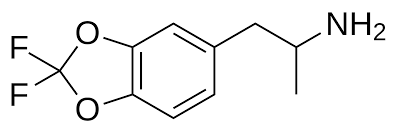
DFMDA, also known as F2-MDA or as 3,4-(difluoromethylenedioxy)amphetamine, is a chemical compound of the phenethylamine, amphetamine, and MDxx families related to the entactogen and psychedelic drugMDA.[2][3][1] It is the derivative of MDA in which the two hydrogenatoms on the carbon atom of the 3,4-methylenedioxyring have been replaced with fluorine atoms.[2][3][1]Daniel Trachsel tested DFMDA in humans and found that it was inactive at doses of up to 250mg orally.[1][2] Higher doses were not tested.[1][2] For comparison, he listed MDA's dose as 80 to 160mg orally.[1]
DFMDA was active at the serotonin transporter (SERT) similarly to MDA and MDMA and with intermediate affinity between the two.[1][2]
It was developed with the aim of finding a non-neurotoxic drug able to be used as a less harmful substitute for entactogens such as MDMA. Since a major route of the normal metabolism of these compounds is scission of the methylenedioxy ring, producing neurotoxic metabolites such as α-methyldopamine, it was hoped that the difluoromethylenedioxy bioisostere would show increased metabolic stability and less toxicity.[3][4][5] These compounds have not yet been tested in animals to verify whether they show similar pharmacological activity to the non-fluorinated parent compounds.[6] It is also now generally accepted that MDMA neurotoxicity results from a variety of different causes and is not solely due to accumulation of α-methyldopamine,[7][8][9] making it unclear how much less neurotoxic DFMDA and related drugs would be in practice.
The chemical synthesis of DFMDA has been described.[3] Some notable analogues of DFMDA include DFMDMA (F2-MDMA), EIDA, and IDA, among others.[1][2] Other fluorinated MDxx derivatives, for instance derivatives of MDEA, BDB, and MBDB, have also been described.[3][2]
DFMDA was first described in the scientific literature by Daniel Trachsel and colleagues in 2006.[3] He described its properties and effects in humans in 2012 and 2013.[1][2]
Difluoromethylenedioxyamphetamine (DiFMDA), identified by CAS number
910393-51-0, is a chemical compound categorized as a substituted phenethylamine and amphetamine derivative.
Wikipedia +1
Based on a search of the provided data, there are no direct commercial retail links or e-commerce platforms listed for purchasing this chemical. As a research chemical within the MDxx family, it is typically sold by specialized chemical suppliers for research purposes, not for public consumption.
Important Safety and Legal Notice:
DFMDA (DiFMDA) is related to controlled substances (such as MDMA) and may fall under analogue laws in various jurisdictions.
The compound is not approved for human consumption.
Always verify the legal status of this substance in your country before attempting to import or acquire it.
For specific sourcing, you would need to contact chemical manufacturers directly to inquire about availability and safety documentation (SDS).
DFMDA - Wikipedia
DFMDA, also known as F2-MDA or as 3,4-(difluoromethylenedioxy)amphetamine, is a chemical compound of the phenethylamine, amphetami...
Cas number 910393-51-0. Formula C10H11F2NO2. Molar Mass 215.200 g·mol−1. Purity 98.0 % min. Formulation Powder, Solid, Crystals. Appearance Powder, Crystaline ...Read more
DFMDA
Wikipedia
https://en.wikipedia.org › wiki › DFMDA
DFMDA, also known as F2-MDA or as 3,4-(difluoromethylenedioxy)amphetamine, is a chemical compound of the phenethylamine, amphetamine, and MDxx families ...Read more
DIFLUOROMETHYLENEDIOXYA...
Inxight Drugs
https://drugs.ncats.io › drug
CAS. 910393-51-0, PRIMARY. FDA UNII. 8Q2ANL037S, PRIMARY. WIKIPEDIA. DiFMDA, PRIMARY, Difluoromethylenedioxyamphetamine (DiFMDA) is a substituted derivative of ...Read more
19 Dec 2025 — CAS Common Chemistry · retrieved. 10 April 2021. reference URL · https://commonchemistry.cas.org/detail?cas_rn=910393-51-0 · ChemSpider ID.Read more
Reviews
There are no reviews yet.